“I have been haunted, not by ghosts, but by humans.”
I heard the word “Haunt” frequently during the conversation with Grandpa Chom Sanmitr (Comrade Tang) in May 2018. In the 90-year-old former member of the Communist Party of Thailand’s eyes, the Thai government is not different from a ghost who haunts people with their deceptions and promises. Thai government tries to portray the Communist Party of Thailand as a scary ghost but it is very ironic since a ghost (Thai government) tries to deceive people that the other (the Communist Party of Thailand) is the one who haunts them. Creating the attention deviation by proposing the other (who is not included as ‘we’) as an enemy is the Thai government’s handy tactic. The words, Unity, Reconciliation and Peace, are considered to be the most recurring words using in slogans throughout centuries.
Peace in this context may translate into the silence under the dictatorship. There are different layers of silence. It is not only the silence from those who were oppressed by the regime but it also applies to what seems to be a state of peace but there is the structural violence hidden. Throughout these 5-6 years, I have been interested in what seems to be the normal or peaceful state of the country. As I tried to translate this concept into painting, my painting process was questioned and completely changed.
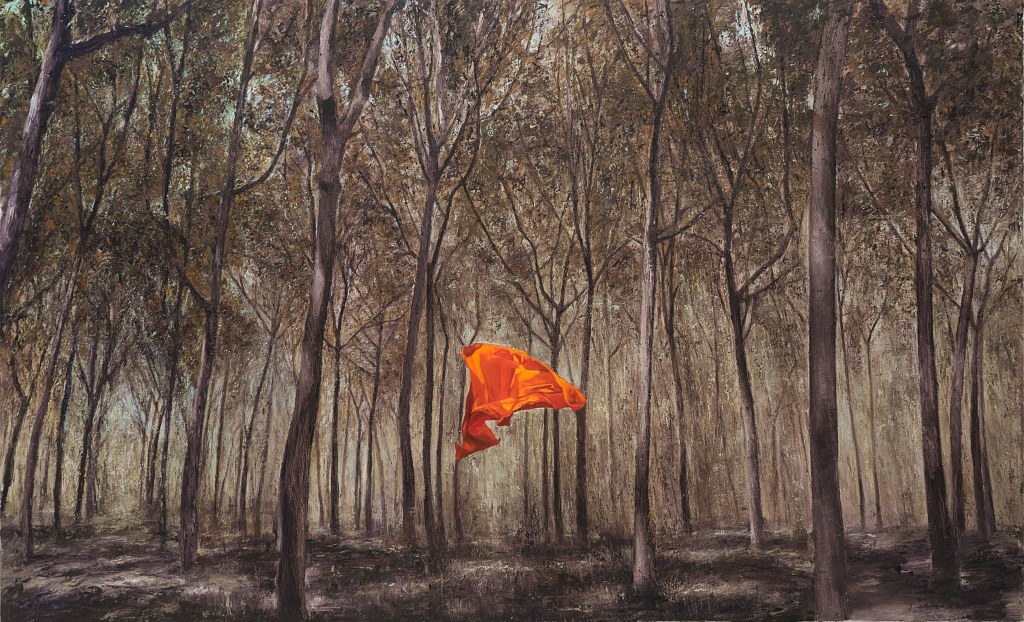
“Ghost”, a series of artworks which I created in 2013-2014, is when I started to question painting. I started to travel out of my inner self to the outer context. I began to search for facts about the social structure. In addition, there was a Thai political crisis at that time. Thus, many discourses were reproduced for political reasons. Since the truth cannot be openly revealed as it should be, I am interested in that shapeless, invisible and hidden thing. This series of paintings is my symbolic interpretation of the words “Nation-Religions-Monarchy”
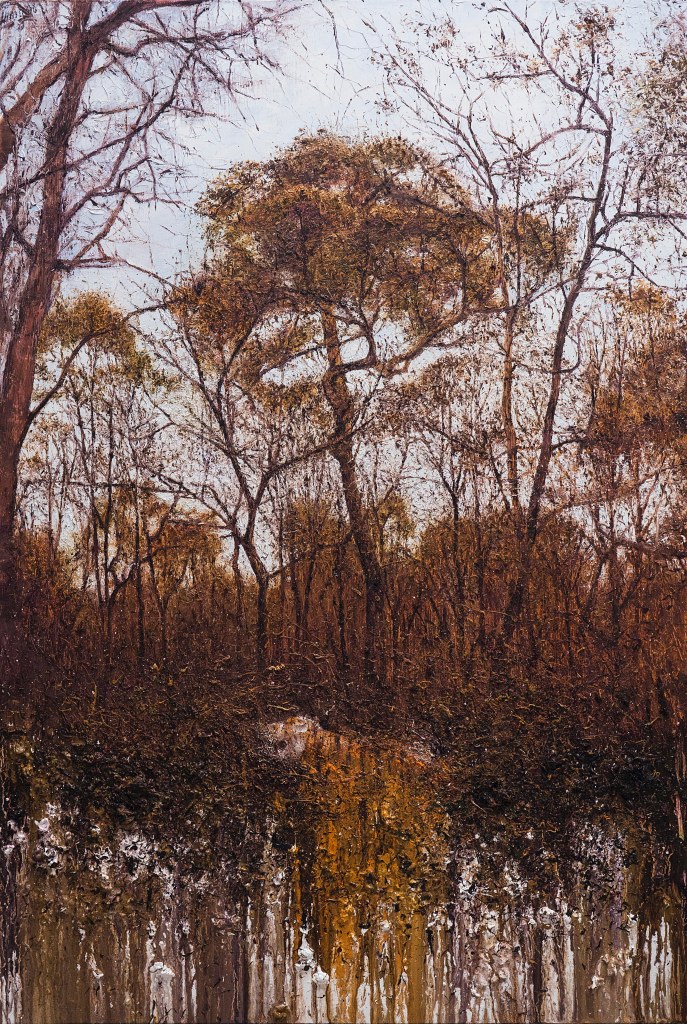
In “Anatomy of Silence”, during 2016-2018, I search for new possibilities in thinking and working. The structure of my painting extends from thinking as words and expressing them in painting to the modified process, (1) searching for the context and content which already exist (2) searching for the representation of truth and (3) representing through the point of view in painting. These three steps are connected and they support each other as one cycle. Representing through the point of view in the painting may act as an introduction to the existed context and content rather than the conclusion. (I chose to use the word ‘point of view in painting’ instead of ‘language of painting’ because there are the external contexts connected to it more than the later term.) The process of searching for the representation led me to the real site and I got a chance to talk to people who got involved in this part of the history such as villagers in the communist village, Grandpa Chom Sanmitr, and Uncle Tor, the current owner of the red-gate house. The environment and the surrounding context that I had been in acted as great materials for painting.
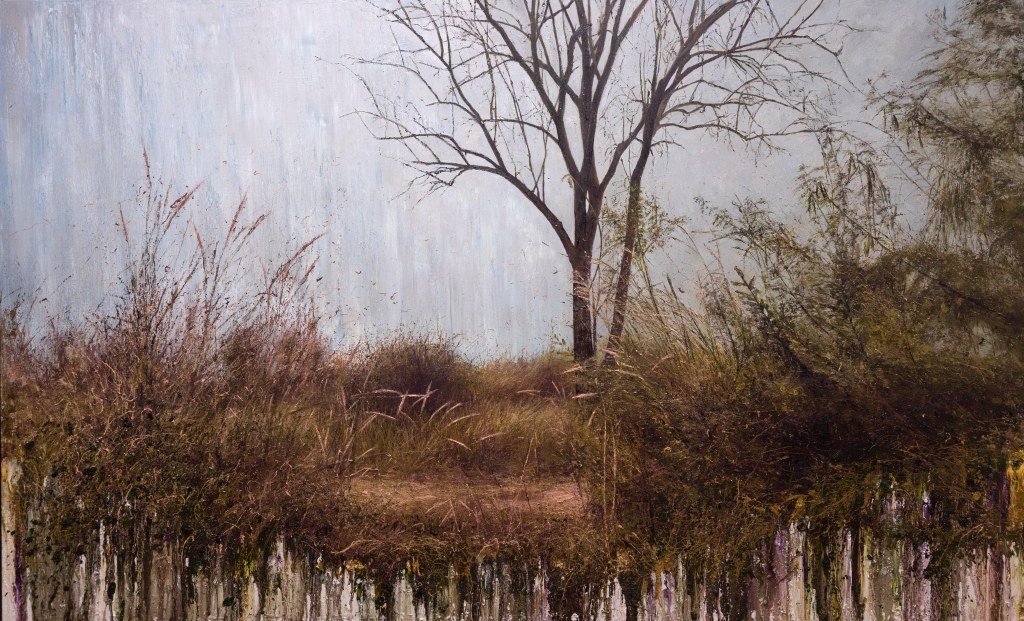
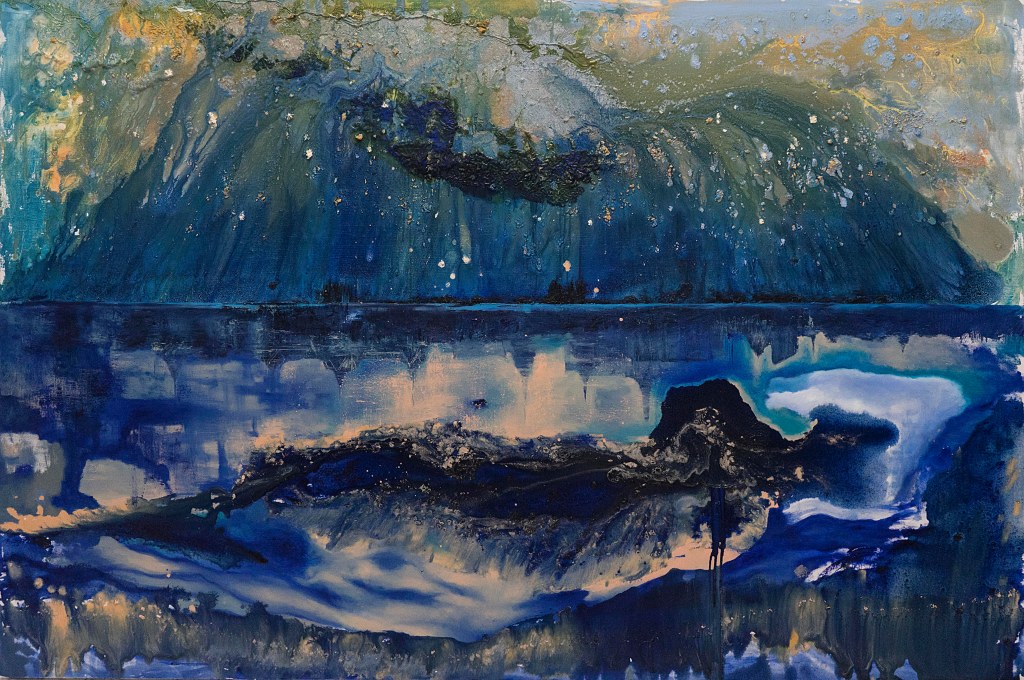
The artwork namely “What a Wonderful World – Parallel side of The Red Gate” is one of the paintings which I surveyed the site to gather materials for working. I got the inspiration from watching “Song Phee Nong, The Two Brothers”, a documentary from “Documentation of Oct 6” project. On September 24, 1976, in Nakhon Pathom, two electricians were hanged to death from the top of a red gate after they went out to put up posters protesting the return to the country of Monk Thanom, who was the former dictator. The documentary revealed the forgotten place and the historical object left behind. I was eager to find the place and when arrived, I was very surprised to see it and its surrounding. For more than 40 years, the red gate has been there on the same spot. The rustic red color and time highlighted this historical object which has been trying to scream silently. I try to represent “the point of view of dead people” in this painting. I highlighted that the painting is an object. (The flat surface of the physical painting) The point of view of the painting and the real red gate are parallel.
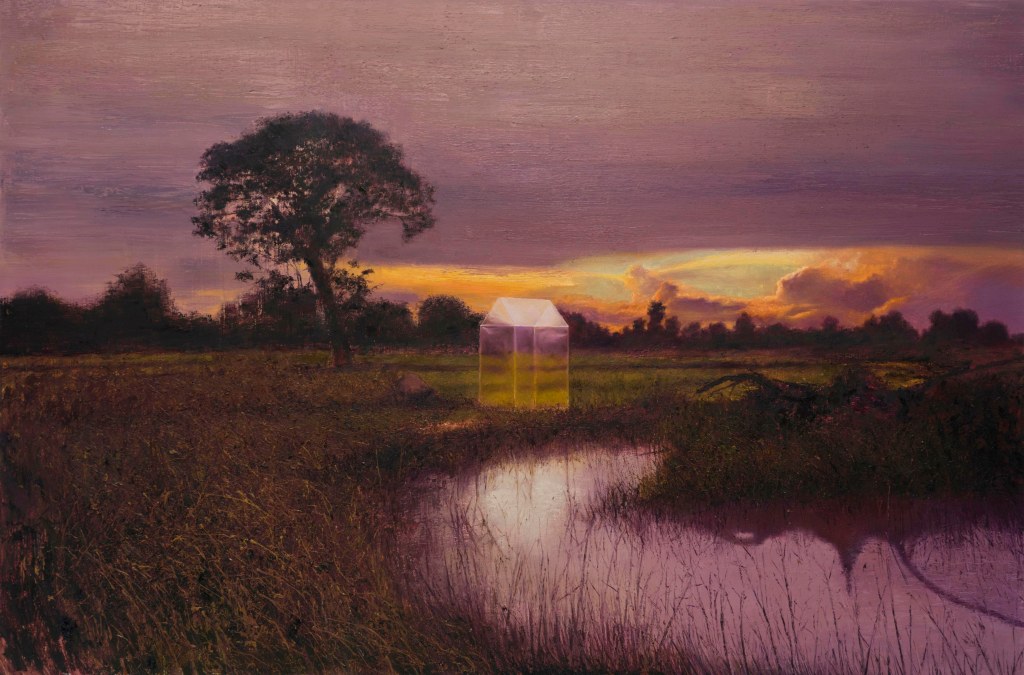
“The Sound of Silence” is one of the works I created after the survey at the communist village, Ban Na Bua, Renu Nakhon District, Nakhon Phanom. I created a new representation which is the mock-up house overlaid the site of “Jood Wan Siang Puen Taek” (the Gunfire Day Spot). The house is transparent, unfunctional, textureless, and incomplete. It is the extension of the interpretation of the work “Ghost” and it questions Prime Minister’s Order 66/2523 or the plan for “Thai Nation Development Cooperators”.1 There are many interesting elements, the remains of Temple Bua Kao’s door facade decoration and the sign of “Paa Prem’s Kindness Playground”, both were built by the military.The temple gate of Wat Bua Kao was built in 1977 and Pha Prem’s Kindness Playground was built in 1979. The site of “Jood Siang Puen Taek” (the Gunfire Spot), on August 20, 1961, and “the Gunfire Day”2, on August 7, 1965, the first gunfight between CPT and authorities were celebrated by CPT. However, the government announced August 7 to be “Wan Siang Puen Dab” (the Last Gunfire Day) to declare the end of the conflict between CPT and authorities. The word “The Sound of Silence” does not intend to play with the name Last Gunfire Day but I intend to use this word to suggest that it means “The disappearance of the gunfire and the arrival of the silent scream”
The specific element which I highlighted in this series of paintings is the surface. Apart from helping to emphasize the depth of a painting, I want to know whether the surface can create the depth for the content or not.
Personally, I looked into the historical events or the things that were made to be forgotten, not only to understand what had happened but also to give respect to what society had lost and I try to connect them with myself. My painting is similar to the act of giving respect and creating the honorable funeral for what had lost. We cry for the lost time, empty coffins, abandoned monuments, and ghosts who sold their spirits for living people. Even though there is no voice shouting for the truth in the end, but the silent and timeless landscape will always bear witness to the land of suffering now covered by the peaceful and blissful landscape.




 Pachara